

Contents
Profile
Ice preparation & ice resurfacer (Zamboni)
- Section
- Ice & technology
- Colloquially
- Zamboni
- Inventor
- Frank J. Zamboni
- First machine
- 1949, California
- Sequence
- Shave, collect snow, wash, lay water
- When
- Intermissions, between training sessions
Why the ice needs to be prepared
After a period of ice hockey or an hour of public skating, the ice is scratched, full of grooves and covered in snow. Blades cut out fine shavings with every stop and turn. On this ice the puck glides unevenly and skaters lose their grip. That is why the ice resurfacer drives over the surface during breaks.
How the ice resurfacer works: step by step
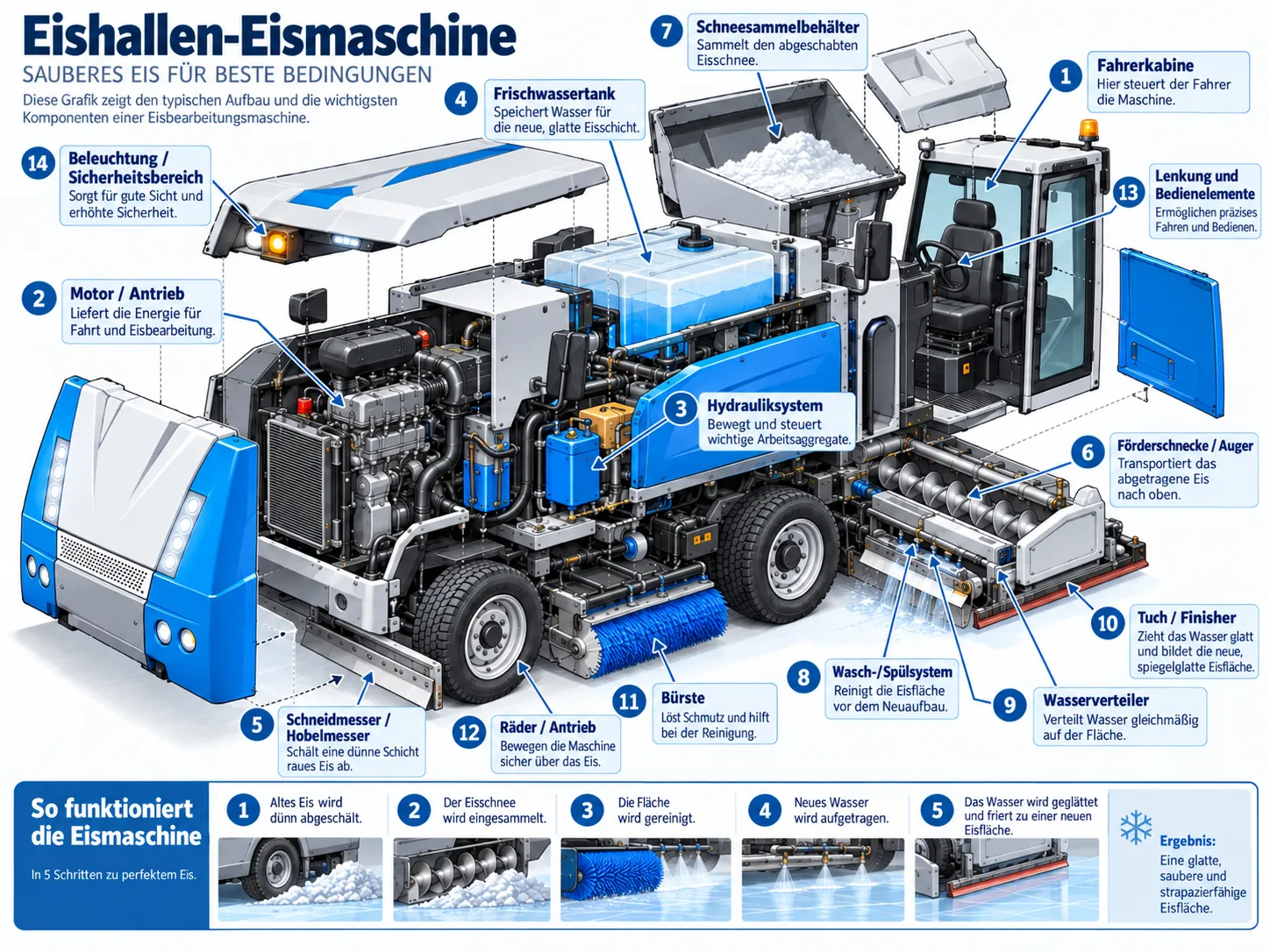
- Shaving: a wide, sharp blade on the underside shaves a wafer-thin layer off the surface. Bumps and grooves disappear.
- Collecting snow: an auger picks up the resulting snow and carries it into a large tank at the front of the machine.
- Washing: in a second step, water is sprayed into the deeper grooves, sucked up and filtered to remove dirt.
- Laying new ice: at the back, a cloth (the "towel") spreads a thin film of warm water evenly over the surface. It freezes into a smooth new layer of ice within a few minutes.
The machine drives in a fixed pattern, usually in overlapping lanes from the outside in. Along the boards, which the machine cannot reach, ice technicians help with edgers and scrapers.
The five assemblies of the ice resurfacer
The 14 components in the diagram can be grouped into five assemblies. Each has its own article with a detailed diagram, explanations of every numbered part, and practical and maintenance notes.
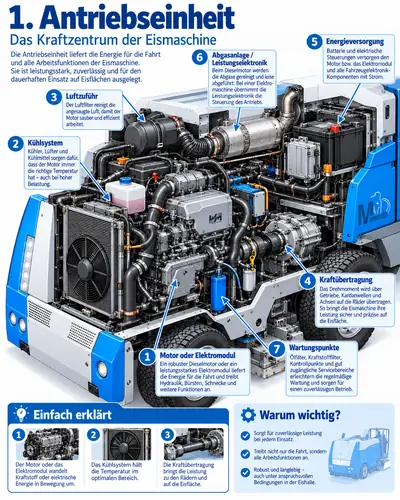 Assembly 1Drive unitDiesel, gas or electric drive powers movement, hydraulics, augers and brush. Cooling, air supply and power keep it reliable in day-to-day rink operation.
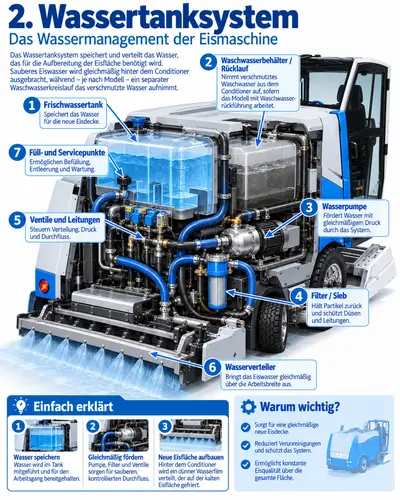 Assembly 2Water tank systemTanks, pump, filters and valves store the ice water and spread it evenly behind the conditioner. Depending on the model there’s a separate circuit for wash water.
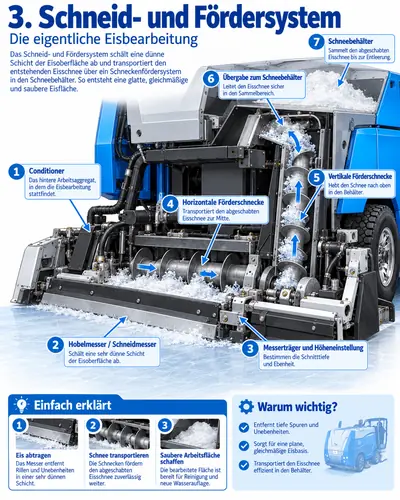 Assembly 3Cutting and conveying systemThe blade in the conditioner shaves off a thin layer of ice. Horizontal and vertical augers move the shavings into the snow tank.
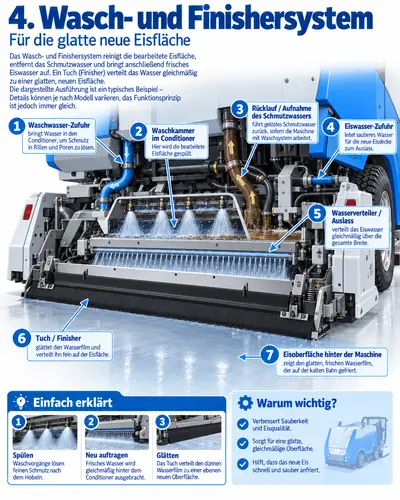 Assembly 4Wash and finisher systemWash water loosens dirt from grooves and is sucked back up. Then the cloth, the finisher, lays a thin film of ice water that freezes into the new ice layer.
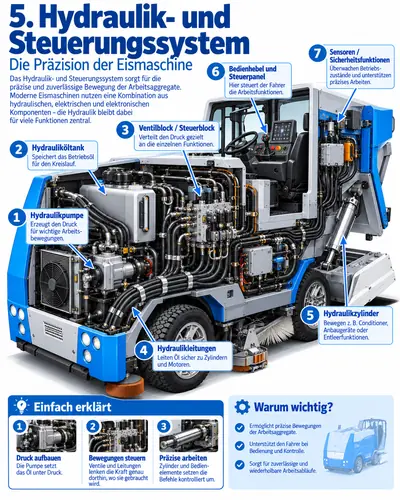 Assembly 5Hydraulic and control systemPump, valve block, lines and cylinders move the conditioner, snow tank and attachments. Control levers, display and sensors give the driver control.
Why warm water?
It sounds paradoxical, but it is physics. Warm water
- melts the top layer of ice very slightly and therefore bonds better with it,
- runs into fine grooves before it freezes,
- contains less dissolved air, which makes the ice clearer and firmer.
The exact temperature used depends on the rink and machine. The water is often treated as well so that no minerals cloud the ice.
The invention of the Zamboni
Before the ice resurfacer, preparation took a long time: several helpers pulled planes across the ice, swept up snow and sprayed water from hoses. Frank J. Zamboni, who ran an ice rink in California, spent years developing a machine that does everything in one pass. In 1949 he completed the first version. Since then, ice resurfacers are often colloquially called "Zambonis", even when made by other manufacturers.
Today, ice resurfacers are increasingly electric, because combustion engines release exhaust fumes in enclosed rinks. Many rinks have therefore converted their fleets.
Ice preparation in numbers and routines
- Resurfacing an ice hockey rink usually takes around ten minutes.
- In professional games the machine goes out in every intermission, often two machines at once.
- In figure skating the ice is resurfaced between warm-up groups so that all skaters have similar conditions.
- Curling has its own rules: instead of the machine, the ice is usually scraped by hand and then pebbled.
How the ice is made in the first place is explained in making ice & ice temperature. Who drives the machine and what else the job involves is covered under ice technician.
Frequently asked questions
+Why does the ice resurfacer use warm water?
Warm water melts the top layer of ice very slightly, fills grooves better, bonds more firmly with the ice and contains less dissolved air. The new ice is therefore smoother and clearer.
+How long does an ice resurfacing take?
On an ice hockey rink usually about ten minutes, which is why it fits well into an intermission.
+Why is the ice resurfacer called a Zamboni?
After Frank Zamboni, who built the first ice resurfacing machine in 1949. Zamboni is a brand name but is often used for all ice resurfacers.
Sources & further links
- Zamboni Company – History
- Wikipedia: Eisbearbeitungsmaschine
- Wikipedia: Frank J. Zamboni
- Zamboni – How It Works
Editorially researched and checked against association and rulebook information. Found a mistake? Write to us via the Contact page.
Read more in the encyclopedia
Background
Ice resurfacer drive unit
The drive unit is the powerhouse of the ice resurfacer: a combustion engine or an electric drive moves the vehicle and at the same time drives the hydraulics that operate the conditioner, augers and brush.
Background
Ice resurfacer cutting and conveying system
The cutting and conveying system is where the actual ice work happens: a blade in the conditioner shaves a thin layer off the surface, and augers carry the resulting ice snow into the snow tank.
Background
Making ice & ice temperature by sport
Artificial ice is made by applying water in many thin layers to a chilled concrete slab containing cooling pipes. The finished ice is usually only a few centimetres thick. The ice is tempered differently depending on the sport: colder and harder for ice hockey and speed skating, slightly warmer and softer for figure skating.
Background
Ice technician: the job behind perfect ice
Ice technicians are responsible for making, maintaining and ensuring the quality of the ice surface in rinks. They drive the ice resurfacer, monitor the refrigeration plant and rink climate, build the ice at the start of the season and adapt it to each sport.
Term
Puck: dimensions, material and why it is frozen
The puck is the hard rubber disc used in ice hockey: 2.54 cm thick, 7.62 cm in diameter and weighing 156 to 170 grams. It is frozen before the game, because frozen rubber bounces less and glides more evenly over the ice.
Background
History of ice rinks and artificial ice
For centuries, ice sports depended on natural ice and cold winters. In 1876 the first artificial ice rink, the Glaciarium, opened in London. Since then, refrigeration technology, covered rinks and modern arenas have made ice sports possible in every season and almost anywhere.
Sport
Ice & technology
Everything about Ice & technology: rules, history, numbers and all terms.