

Contents
Profile
Ice resurfacer hydraulic and control system
- Assembly
- 5 of 5
- Function
- Moving and controlling the working units
- Moves, among others
- Conditioner, augers, snow tank, brush
- Parent topic
- Ice preparation
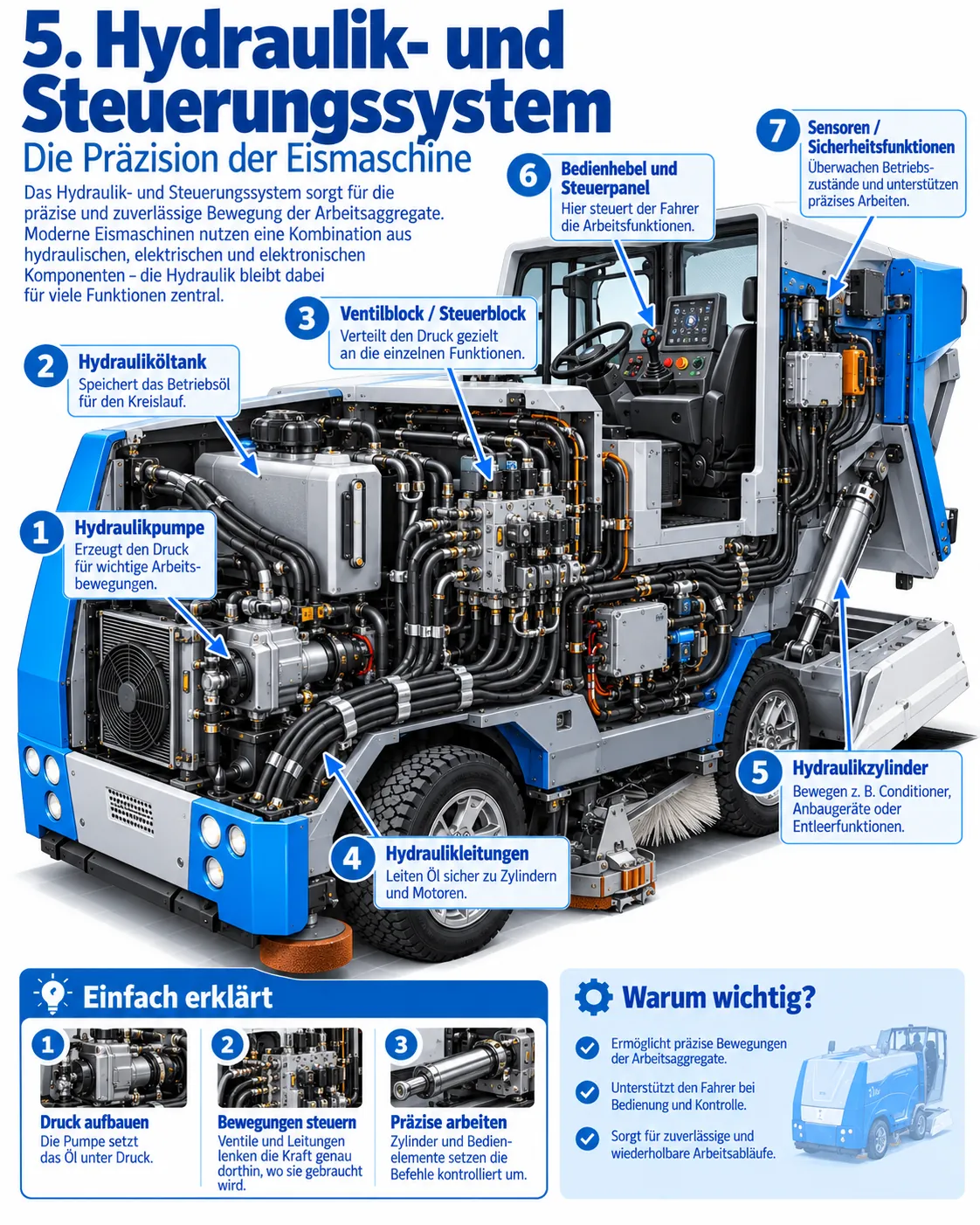
Explained simply
The hydraulics work like the ice resurfacer's muscles. The pump puts oil under pressure. Valves and lines direct this force exactly where it is needed. Cylinders and hydraulic motors carry out the commands from the cab in a controlled way: lower the conditioner, turn the augers, tip the tank. Build pressure, control movements, work precisely.
The components at a glance
The numbers correspond to the diagram. It shows a typical arrangement; position and design of the components depend on the model.
- Hydraulic pump: generates the pressure for the working movements and is driven by the engine or its own electric motor. According to Wikipedia, the vehicle drive feeds both driving and the hydraulics.
- Hydraulic oil tank: stores the operating oil for the circuit. WM technics specifies a 50-litre oil tank for the Mammoth; other models have different volumes.
- Valve block / control block: distributes the pressure to the individual functions. On modern machines, electrically switched valves are combined in one block.
- Hydraulic lines: hoses and pipes carry the oil safely to cylinders and hydraulic motors. They must withstand pressure, cold and movement over the long term.
- Hydraulic cylinders: move, for example, the conditioner, attachments or the snow tank's emptying function. The augers are also hydraulically driven; on Zamboni machines, according to the manual, the horizontal and vertical augers are connected in series.
- Control levers and control panel: this is where the driver controls the working functions. Besides classic levers, newer machines use displays and a programmable logic controller (PLC), as WM technics states for the Mammoth.
- Sensors / safety functions: monitor operating states and support precise work, for example fluid levels, temperatures or the position of the conditioner and tank.
Hydraulics and electronics working together
Older ice resurfacers were mainly mechanical-hydraulic: the driver moved levers that switched valves directly. Today the hydraulics are usually combined with electrical and electronic components. A switch in the cab operates a solenoid valve, while a controller monitors sensor values and can prevent operating errors. The Zamboni manual describes, for example, that the vertical auger can also be reversed via a valve and the horizontal auger turns with it because both are hydraulically connected in series.
Brakes can also be hydraulic. For the Mammoth, WM technics specifies a service brake with hydraulic brake booster and a hydraulic parking brake. Such details vary greatly between manufacturers.
Why it matters
The hydraulic system allows precise, repeatable movements of the working units. The conditioner must lie on the ice with even pressure so that the blade cuts evenly; the augers must reliably convey the snow; the tank must tip safely. Well-tuned controls take the load off the driver, who has to steer, meter water and watch the boards at the same time. A hydraulic leak also risks oil on the ice – something that must be avoided at all costs.
Maintenance and practice
- Oil level and leaks: before every run, check the level and look for oil traces, especially on hoses and fittings.
- Filters: change hydraulic oil filters as scheduled. WM technics supplies the Mammoth with a wrench for water and hydraulic oil filters.
- Hoses: look out for cracks, chafing and kinks; replace damaged lines immediately.
- Function test: raise and lower the conditioner, run the augers briefly, check the tank tipping function – ideally before the first run of the day.
- Safety: never work under a raised snow tank without securing it against lowering as described in the manual.
Operating from the cab
For the driver, the controls are the most important tool. They steer with one hand and operate levers or switches for conditioner, augers and water with the other. Well-arranged controls and a clear display reduce errors, especially under time pressure in an intermission. Many rinks therefore train new drivers outside game times first before they resurface during competitions.
Read more
This completes the tour of the five assemblies; the overview shows how everything works together.
- Ice preparation & ice resurfacer: the overview
- Ice technician: who drives the machine
- Ice temperature: why degrees matter
- Zamboni history: how it all began
Frequently asked questions
+What do the hydraulics do on an ice resurfacer?
They lower and raise the conditioner, drive the augers, tip the snow tank for emptying and move attachments such as the board brush.
+How can you spot a hydraulic problem?
Typical signs are oil stains under the machine, sluggish or jerky movements, unusual noises or warning messages on the display. The machine then belongs in the workshop.
+Are there ice resurfacers without hydraulics?
Modern machines combine hydraulics with electrical and electronic components. Hydraulics remain central for many working functions; the exact share depends on the model.
Sources & further links
- Wikipedia (en): Ice resurfacer
- Zamboni 450 Electric – Operating Instructions (ManualsLib)
- Zamboni 552AC – Operating Instructions (ManualsLib)
- WM technics – Mammoth (product page)
- WM technics – Mammoth product sheet (PDF)
- Wikipedia: Eisbearbeitungsmaschine
Editorially researched and checked against association and rulebook information. Found a mistake? Write to us via the Contact page.
Read more in the encyclopedia
Background
Ice preparation & ice resurfacer (Zamboni)
The ice resurfacer shaves a thin layer off the ice, collects the resulting snow, cleans the surface and lays down a thin film of warm water that freezes into a smooth new layer of ice. Frank Zamboni built the first such machine in California in 1949.
Background
Ice technician: the job behind perfect ice
Ice technicians are responsible for making, maintaining and ensuring the quality of the ice surface in rinks. They drive the ice resurfacer, monitor the refrigeration plant and rink climate, build the ice at the start of the season and adapt it to each sport.
Background
Making ice & ice temperature by sport
Artificial ice is made by applying water in many thin layers to a chilled concrete slab containing cooling pipes. The finished ice is usually only a few centimetres thick. The ice is tempered differently depending on the sport: colder and harder for ice hockey and speed skating, slightly warmer and softer for figure skating.
Background
Zamboni: history of the ice resurfacer
The Zamboni is the best-known ice resurfacer in the world. It was invented by Californian Frank J. Zamboni, who built a first working model for his own rink in 1949. Today the brand name stands worldwide for the machine that smooths the ice during breaks.
Sport
Ice & technology
Everything about Ice & technology: rules, history, numbers and all terms.