

Contents
Profile
Ice resurfacer wash and finisher system
- Assembly
- 4 of 5
- Function
- Washing the ice, smoothing the new water layer
- Core component
- Towel (finisher) on the conditioner
- Parent topic
- Ice preparation
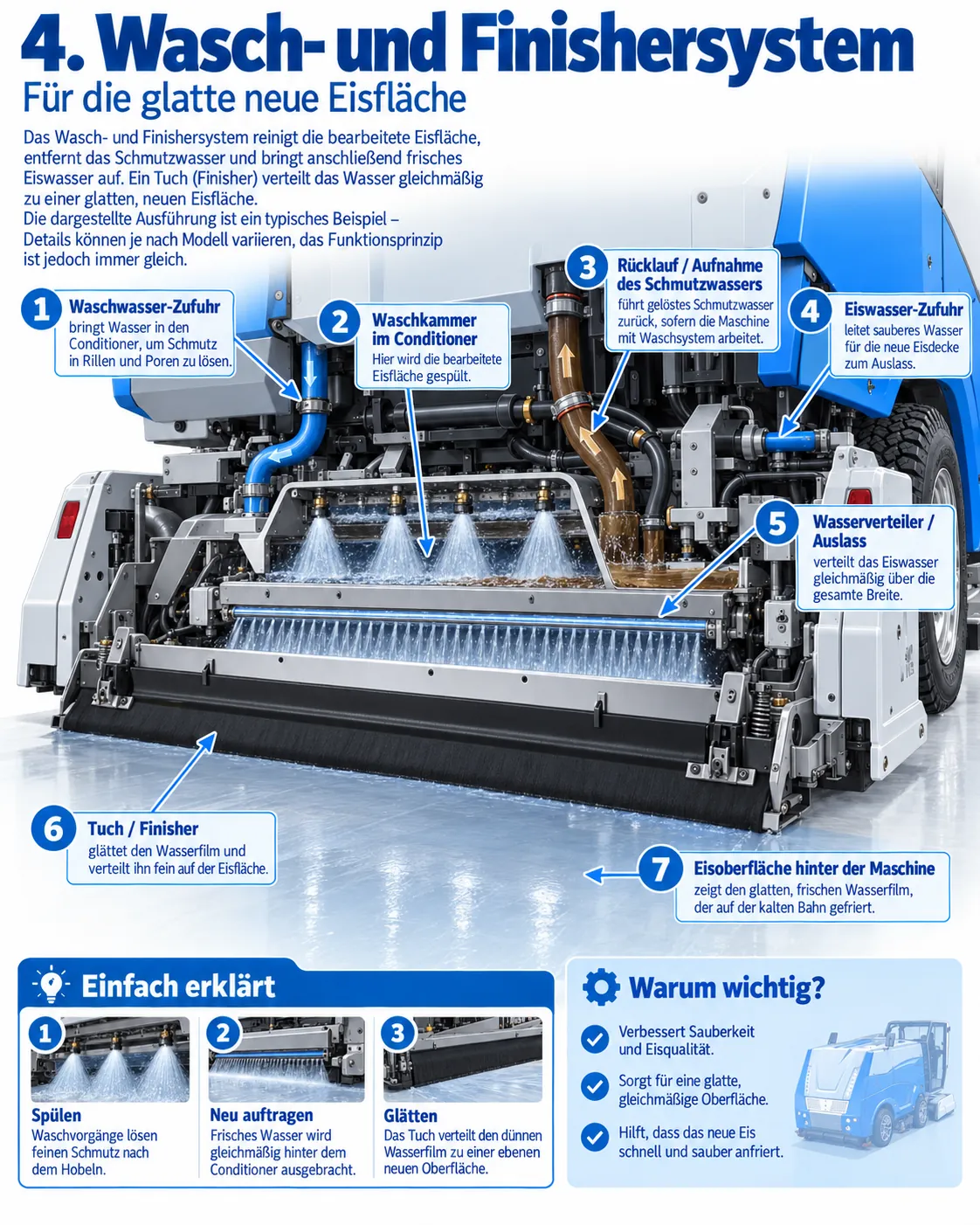
Explained simply
First rinse, then reapply, then smooth. After shaving, water jets loosen fine dirt from the grooves, and the dirty water is immediately sucked back up. Then fresh water runs behind the conditioner onto a towel that spreads the thin water film evenly over the surface. On the cold base it freezes into a new, smooth surface.
The components at a glance
The numbers correspond to the diagram. It shows a typical design; not every machine has a wash circuit.
- Wash water supply: brings water into the conditioner to loosen dirt from grooves and pores. According to Wikipedia, the nozzles sit directly in front of the blade and spray the water forcefully into the ice.
- Wash chamber in the conditioner: this is where the worked surface is rinsed. According to Wikipedia, side runners keep the spray inside the conditioner.
- Return / dirty water pickup: carries loosened dirty water back if the machine works with a wash system. A rubber squeegee and a suction nozzle pick up the water; in the Zamboni system it is filtered and reused, while WM technics directs it into the snow tank via a suction bar.
- Ice-making water supply: carries clean water for the new ice surface to the outlet, separate from the wash water.
- Water spreader / outlet: a spray pipe distributes the ice-making water evenly across the whole width. WM technics also mentions metering for cornering, so that not too much water lands on the inside.
- Towel / finisher: the trailing towel smooths the water film and spreads it finely on the ice. According to Wikipedia, it ensures smooth, controlled water application.
- Ice surface behind the machine: shows the smooth, fresh water film freezing on the cold surface.
Washing and finishing in sequence
Both steps happen at the same time during the run, just one behind the other in the conditioner. The Zamboni manual describes the aim like this: the ice is shaved, the snow collected, the ice washed with the wash water system and a final layer of water applied. Rink staff used to do this with scrapers, brooms and hoses in separate passes; the ice resurfacer combines everything in one run. More on its origins in Zamboni history.
The driver continuously decides how much water to apply. Too much water freezes slowly and can form puddles; too little does not fill the grooves. In curves the machine moves more slowly on the inside than on the outside, so the amount of water is often adjusted there.
Why it matters
This is where the surface that people play and skate on is created. Clean water on clean ice gives clear, hard ice; dirt, by contrast, freezes in and makes the surface dull and dark. The towel ensures that the new layer is equally thin everywhere and freezes quickly and cleanly. A surface that shines evenly after the pass is the most visible sign of good ice preparation.
Maintenance and practice
- Look after the towel: clean it after use and let it dry; replace it when worn. Manufacturers usually supply spare towels; the WM Mammoth comes with two.
- Nozzles and spray pipe: check for blockages, because a clogged nozzle leaves visible streaks.
- Runners and squeegees: side runners and rubber lips wear out. WM technics describes replaceable plastic runners.
- Wash water: according to the Zamboni 552AC manual, the wash water tank is filled with cold water before washing.
When to wash
Not every resurfacing needs the full wash cycle. After a training session with few spectators, shaving and reapplying is often enough. After games, public skating or events there is more dirt, dust and foreign particles on the ice, and the wash system pays off. How often a rink washes is part of its own care routine and also depends on water consumption and water quality.
Read more
Assembly 5 explains the hydraulics that move the conditioner, augers and snow tank.
- Ice preparation & ice resurfacer: the overview
- Ice technician: who drives the machine
- Ice temperature: why degrees matter
- Zamboni history: how it all began
Frequently asked questions
+What is the finisher?
The towel dragged over the ice behind the conditioner. It is wetted with ice-making water from above and spreads it as an even, thin film.
+Do you have to wash every time?
Not necessarily. The wash system is switched on depending on how dirty the ice is and the rink's routine; according to Zamboni, regular washing leads to a cleaner, high-quality ice surface.
+Why is the surface wet after the ice resurfacer?
The applied water film has to freeze first. Depending on ice and rink temperature, this takes a few minutes, which is why the surface is only released afterwards.
Sources & further links
- Wikipedia (en): Ice resurfacer
- Zamboni – How It Works
- Zamboni 552AC – Operating Instructions (ManualsLib)
- WM technics – High-performance Conditioner
- WM technics – Mammoth (product page)
- Wikipedia: Eisbearbeitungsmaschine
Editorially researched and checked against association and rulebook information. Found a mistake? Write to us via the Contact page.
Read more in the encyclopedia
Background
Ice preparation & ice resurfacer (Zamboni)
The ice resurfacer shaves a thin layer off the ice, collects the resulting snow, cleans the surface and lays down a thin film of warm water that freezes into a smooth new layer of ice. Frank Zamboni built the first such machine in California in 1949.
Background
Ice technician: the job behind perfect ice
Ice technicians are responsible for making, maintaining and ensuring the quality of the ice surface in rinks. They drive the ice resurfacer, monitor the refrigeration plant and rink climate, build the ice at the start of the season and adapt it to each sport.
Background
Making ice & ice temperature by sport
Artificial ice is made by applying water in many thin layers to a chilled concrete slab containing cooling pipes. The finished ice is usually only a few centimetres thick. The ice is tempered differently depending on the sport: colder and harder for ice hockey and speed skating, slightly warmer and softer for figure skating.
Background
Zamboni: history of the ice resurfacer
The Zamboni is the best-known ice resurfacer in the world. It was invented by Californian Frank J. Zamboni, who built a first working model for his own rink in 1949. Today the brand name stands worldwide for the machine that smooths the ice during breaks.
Sport
Ice & technology
Everything about Ice & technology: rules, history, numbers and all terms.