

Contents
Profile
Ice resurfacer cutting and conveying system
- Assembly
- 3 of 5
- Function
- Shaving ice, removing snow
- Core component
- Conditioner with blade
- Parent topic
- Ice preparation
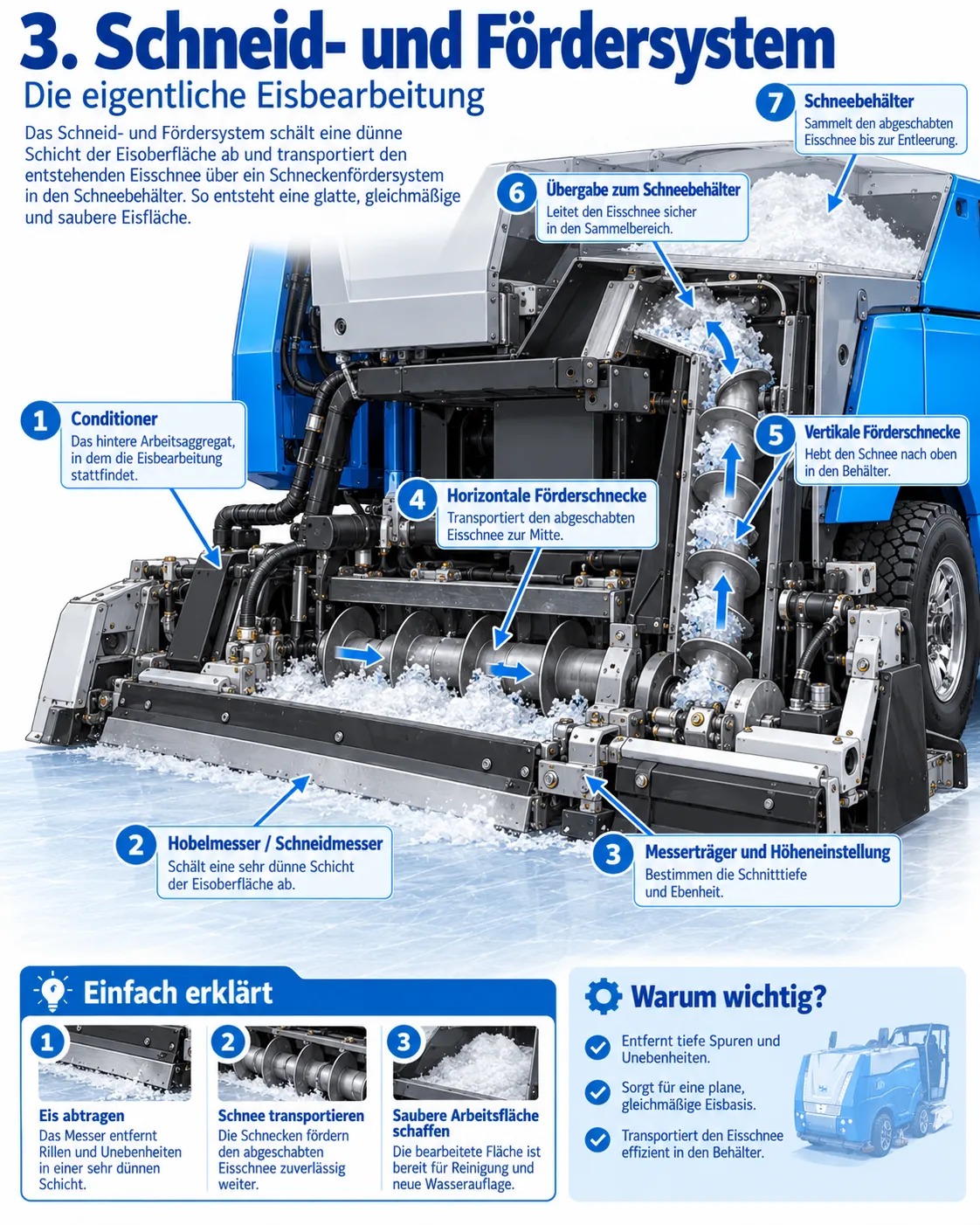
Explained simply
First, the old, scratched ice is removed. A wide blade takes away grooves and bumps in a very thin layer. The augers reliably carry the ice snow onwards and up into the large tank. What remains is a clean, flat working surface, ready for cleaning and a new layer of water.
The components at a glance
The numbers correspond to the diagram. The working principle is similar on all common machines; design and details vary.
- Conditioner: the rear working unit where the ice is worked. It is lowered hydraulically onto the ice; its weight ensures the blade bites.
- Blade: a long, very sharp blade on the underside shaves a thin layer off the ice surface. English Wikipedia compares it to the blades of industrial paper cutters.
- Blade holder and height adjustment: determine cutting depth and flatness. The blade is fine-tuned via hand wheels or levers; WM technics mentions sight windows through which the position of the blade bar can be read exactly.
- Horizontal auger: runs across the width of the conditioner and pushes the shaved ice snow towards the middle.
- Vertical auger: lifts the snow upwards. According to the Zamboni manual, the horizontal and vertical augers are hydraulically connected in series.
- Transfer to the snow tank: at the top, the snow is thrown into the collection area and spread out.
- Snow tank: collects the ice snow until it is emptied and takes up most of the body on many machines.
What happens during shaving
Every resurfacing removes ice, which is then replaced by a new layer of water. The aim is to keep both in balance: shave too little and bumps grow and the ice gets thicker; shave too much and the ice gets thinner over the season. Ice technicians therefore regularly check the ice thickness at several points and adjust the cutting depth.
Corners and boards need particular care. The conditioner does not reach right up to the boards; a side board brush or edger helps there. According to the Zamboni manual, the board brush and edger are optional equipment.
Why it matters
The cutting system removes deep marks and unevenness and creates a flat, even ice base. Only on a level surface can the new water later freeze in an equally thin layer. A blunt or crookedly set blade leaves grooves or "steps" that players and skaters notice immediately. At the same time, the snow must be picked up completely: snow left behind freezes into the new layer and makes it dull.
Maintenance and practice
- Check the blade: the Zamboni manual explicitly lists "check blade" and "adjust blade" as pre-run steps.
- Blade change: blades are sharpened and replaced. Because they are so sharp, cut-resistant gloves and a transport box are part of the job; WM technics supplies such gloves as accessories.
- Keep the augers clear: foreign objects such as pucks, stick parts or screws can block the augers. Check the surface before use.
- Empty the snow tank: empty it into the snow pit after every run so the machine has full capacity next time.
Typical faults
Many problems on the ice can be traced directly to the cutting system. Snow residue in the lanes points to a full or blocked auger. A step between two lanes is often caused by a crookedly set blade. Chatter marks indicate a blunt blade or driving too fast. And if the ice gets thinner over weeks, the shaving is probably too deep. Ice technicians read such marks and correct the setting before the next run.
Read more
Assembly 4 shows how the shaved ice is washed and given a new coat with the towel.
- Ice preparation & ice resurfacer: the overview
- Ice technician: who drives the machine
- Ice temperature: why degrees matter
- Zamboni history: how it all began
Frequently asked questions
+How deep does the blade cut?
Only a thin layer. The driver or ice technician sets the exact cutting depth via the blade holder; it depends on the ice condition and the aim of the resurfacing.
+Where does the ice snow go?
The horizontal auger pushes it to the middle and the vertical auger lifts it into the snow tank. After the run, the tank is tipped hydraulically and emptied into a snow pit.
+How often does the blade need changing?
That depends on use and ice. Blades are regularly sharpened and replaced; some manufacturers offer quick-change systems.
Sources & further links
- Wikipedia (en): Ice resurfacer
- Zamboni – How It Works
- Zamboni 552AC – Operating Instructions (ManualsLib)
- Zamboni 450 Electric – Operating Instructions (ManualsLib)
- WM technics – High-performance Conditioner
- WM technics – Mammoth (product page)
- Wikipedia: Eisbearbeitungsmaschine
Editorially researched and checked against association and rulebook information. Found a mistake? Write to us via the Contact page.
Read more in the encyclopedia
Background
Ice preparation & ice resurfacer (Zamboni)
The ice resurfacer shaves a thin layer off the ice, collects the resulting snow, cleans the surface and lays down a thin film of warm water that freezes into a smooth new layer of ice. Frank Zamboni built the first such machine in California in 1949.
Background
Ice technician: the job behind perfect ice
Ice technicians are responsible for making, maintaining and ensuring the quality of the ice surface in rinks. They drive the ice resurfacer, monitor the refrigeration plant and rink climate, build the ice at the start of the season and adapt it to each sport.
Background
Making ice & ice temperature by sport
Artificial ice is made by applying water in many thin layers to a chilled concrete slab containing cooling pipes. The finished ice is usually only a few centimetres thick. The ice is tempered differently depending on the sport: colder and harder for ice hockey and speed skating, slightly warmer and softer for figure skating.
Background
Zamboni: history of the ice resurfacer
The Zamboni is the best-known ice resurfacer in the world. It was invented by Californian Frank J. Zamboni, who built a first working model for his own rink in 1949. Today the brand name stands worldwide for the machine that smooths the ice during breaks.
Sport
Ice & technology
Everything about Ice & technology: rules, history, numbers and all terms.