

Contents
Profile
Ice resurfacer water tank system
- Assembly
- 2 of 5
- Function
- Storing, filtering and distributing water
- Types of water
- Ice-making water (usually warm), wash water
- Parent topic
- Ice preparation
Explained simply
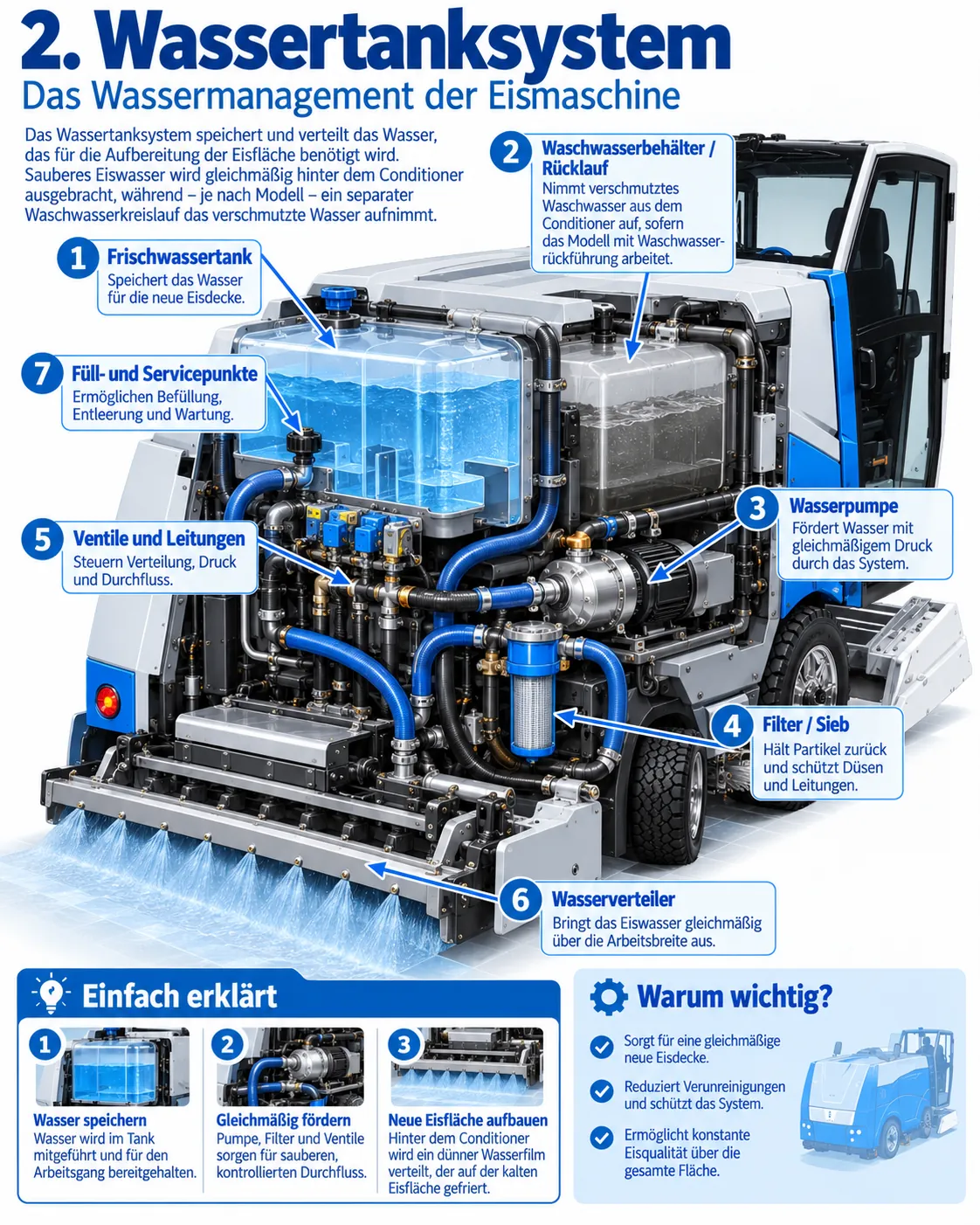
The ice resurfacer carries its water onto the ice in tanks. Pump, filter and valves make sure it flows cleanly and evenly. Behind the conditioner, a thin film of water runs onto the cold ice and freezes there into the new ice surface. In short: store water, deliver it evenly, build a new ice surface.
The components at a glance
The numbers correspond to the diagram. It shows a typical design; tank layout and plumbing differ by manufacturer.
- Fresh water tank: stores the clean ice-making water for the new ice surface. Zamboni describes a separate tank for the "ice making water", which on many models is made of plastic.
- Wash water tank / return: collects dirty wash water from the conditioner if the model works with wash water recirculation. In the Zamboni manual it runs back into the wash water tank through a filter screen.
- Water pump: delivers water through the system at even pressure and sucks the dirty water back up during washing.
- Filter / screen: holds back particles and protects nozzles and lines. A clogged screen is a common cause of uneven water patterns.
- Valves and lines: control distribution, pressure and flow. The driver opens ice-making and wash water separately, usually via levers or switches in the cab.
- Water spreader: spreads the ice-making water evenly across the whole working width – in the classic design onto the trailing towel.
- Filling and service points: allow filling, draining and maintenance. Some machines can be filled via automatic filling systems; WM technics, for example, mentions an automatic filling function with drive interlock.
Warm water for the new ice layer
Why does warm water go onto the ice? Zamboni writes in the 450 Electric manual that warm ice-making water usually gives the best surface. It melts the top layer of ice very slightly, bonds well with it and flows into grooves more easily. At the same time, the manufacturer gives an upper limit: water above 70 °C (160 °F) can damage the plastic tank. The actual temperature a rink uses is set by ice technicians based on experience, water quality and ice temperature.
For wash water, by contrast, the Zamboni 552AC manual says: fill the wash water tank with cold water. It is meant to loosen and rinse, not to freeze on.
Why it matters
The water tank system determines how even the new ice layer will be. Too much water in one spot leads to puddles that freeze slowly and form bumps; too little leaves grooves open. A constant flow across the whole width ensures a flat surface. Clean filters and a separate wash circuit keep dirt away from the new ice, because anything floating in the water freezes in with it.
Maintenance and practice
- Before use: check water levels and open the ice-making and wash water valves as per the procedure. The Zamboni manual lists both in the typical start-up sequence in the machine room.
- Filters and screens: clean regularly, especially the screen in the wash water return, where dirt and bits of ice collect.
- Drain the tanks: rinse and drain as specified by the manufacturer so that no deposits form.
- Water quality: limescale and minerals affect the clarity and hardness of the ice. Many rinks therefore treat their water; the approach is rink-specific.
Water and the rink climate
Whatever the machine applies, the refrigeration plant has to remove again. Every resurfacing brings heat and moisture into the rink: warm water gives off heat to the ice and some of it evaporates. Ice technicians therefore match water quantity, water temperature and the interval between resurfacings to refrigeration capacity and rink ventilation. Otherwise fog or frost can form when humidity is high.
Read more
Assembly 3 moves on to the actual ice work: blade and augers in the conditioner.
- Ice preparation & ice resurfacer: the overview
- Ice technician: who drives the machine
- Ice temperature: why degrees matter
- Zamboni history: how it all began
Frequently asked questions
+Why does an ice resurfacer have two water tanks?
Many models separate clean ice-making water for the new ice layer from wash water, which flushes dirt out of the grooves and is sucked back up. Whether and how this is done depends on the model.
+Is the wash water reused?
On machines with a wash system, according to the Zamboni manual it is sucked up, filtered through a screen and can be reused in the circuit.
+How much water does the tank hold?
That depends on the model. Large stadium machines have considerably more volume than compact machines for small surfaces; the figures are in the manufacturer's data sheet.
Sources & further links
- Zamboni – How It Works
- Zamboni 450 Electric – Operating Instructions (ManualsLib)
- Zamboni 552AC – Operating Instructions (ManualsLib)
- Wikipedia (en): Ice resurfacer
- WM technics – Mammoth (product page)
- Wikipedia: Eisbearbeitungsmaschine
Editorially researched and checked against association and rulebook information. Found a mistake? Write to us via the Contact page.
Read more in the encyclopedia
Background
Ice preparation & ice resurfacer (Zamboni)
The ice resurfacer shaves a thin layer off the ice, collects the resulting snow, cleans the surface and lays down a thin film of warm water that freezes into a smooth new layer of ice. Frank Zamboni built the first such machine in California in 1949.
Background
Ice technician: the job behind perfect ice
Ice technicians are responsible for making, maintaining and ensuring the quality of the ice surface in rinks. They drive the ice resurfacer, monitor the refrigeration plant and rink climate, build the ice at the start of the season and adapt it to each sport.
Background
Making ice & ice temperature by sport
Artificial ice is made by applying water in many thin layers to a chilled concrete slab containing cooling pipes. The finished ice is usually only a few centimetres thick. The ice is tempered differently depending on the sport: colder and harder for ice hockey and speed skating, slightly warmer and softer for figure skating.
Background
Zamboni: history of the ice resurfacer
The Zamboni is the best-known ice resurfacer in the world. It was invented by Californian Frank J. Zamboni, who built a first working model for his own rink in 1949. Today the brand name stands worldwide for the machine that smooths the ice during breaks.
Sport
Ice & technology
Everything about Ice & technology: rules, history, numbers and all terms.