

Contents
Profile
Ice resurfacer drive unit
- Assembly
- 1 of 5
- Function
- Driving and powering all work functions
- Drive types
- Petrol/gas, diesel or electric (battery)
- Parent topic
- Ice preparation
Explained simply
The drive unit is the "heart" of the ice resurfacer. The engine or electric module converts fuel or electricity into motion. The cooling system keeps the temperature in the right range, and the power transmission delivers the power to the wheels and thus safely onto the ice. Without this assembly nothing moves – and no auger turns either.
The components at a glance
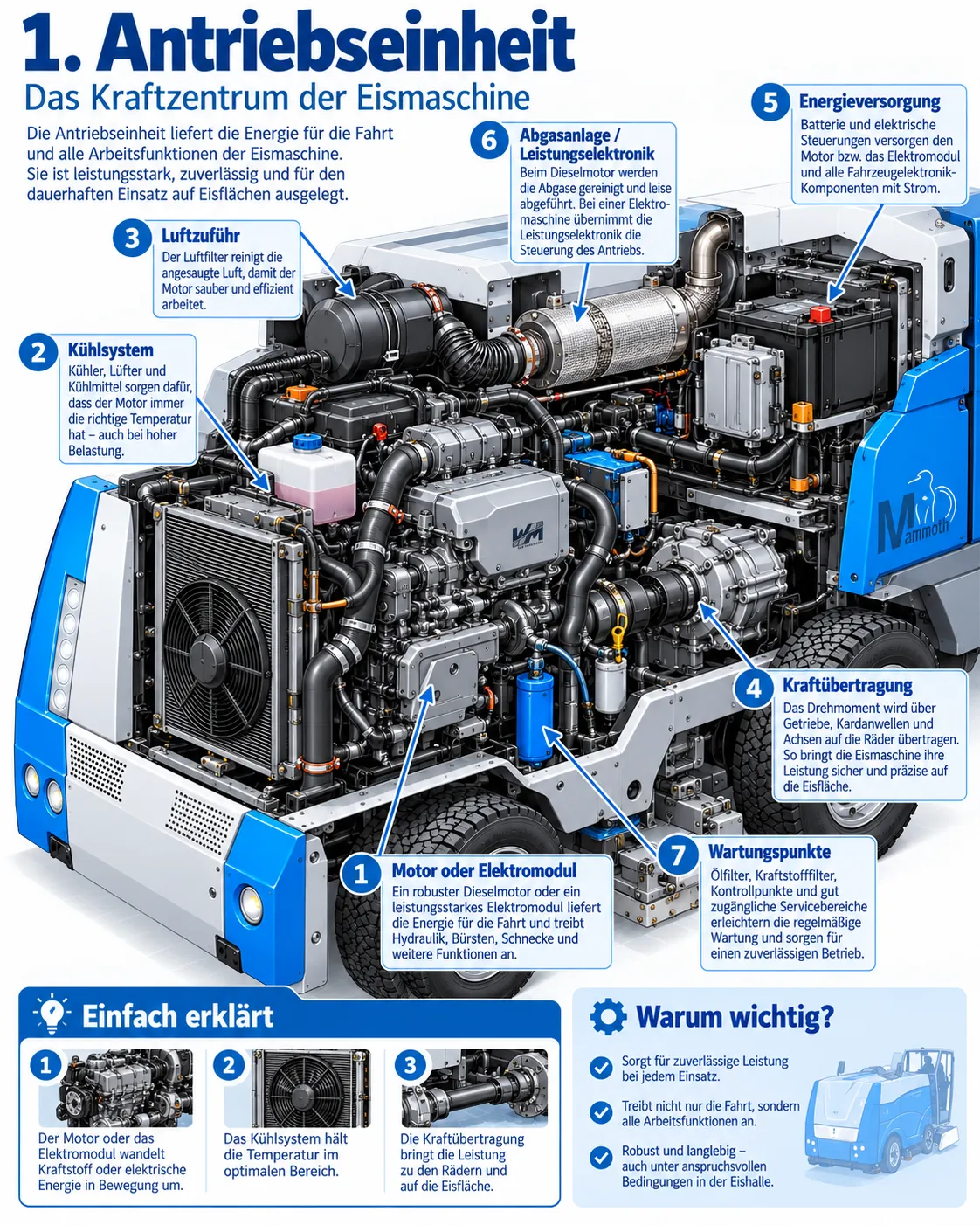
The numbers correspond to the diagram above. It shows a typical design; exactly which parts are fitted depends on the manufacturer and model.
- Engine or electric module: a robust combustion engine or electric drive supplies the energy for driving and at the same time drives the hydraulic pump. This powers the conditioner, augers and brush.
- Cooling system: radiator, fan and coolant keep the engine at operating temperature even under continuous load. On electric machines, heat sinks or a cooling circuit do this job for motor, battery and electronics.
- Air intake: the air filter cleans the intake air so that the engine runs cleanly and efficiently. The air in an ice rink is cold and damp, so a clean filter is part of every routine check.
- Power transmission: gearbox, drive shafts and axles deliver torque to the wheels. Some modern electric machines use an infinitely variable electric all-wheel drive, as WM technics describes for its Mammoth model.
- Power supply: the battery and electrical controls supply the engine or electric module and all vehicle electronics with power, from the starter to the lights.
- Exhaust system / power electronics: on a combustion engine, exhaust gases are cleaned and discharged. On an electric machine, the power electronics at this point control the drive and regulate speed and output.
- Maintenance points: oil filter, fuel filter, check points and easily accessible service areas make regular maintenance easier. Many manufacturers make the engine bay accessible via hinged covers.
Combustion or electric?
For a long time, ice resurfacers with combustion engines dominated. The English-language technical literature names combustion engines and electric motors as typical drives, both moving the vehicle and feeding the hydraulics. In enclosed rinks, air quality is an important issue: a combustion engine releases exhaust into the space, which the rink ventilation must remove. Battery-electric machines avoid these local emissions and are also quieter.
The range has grown accordingly. Zamboni offers electric models such as the 552AC, the Slovenian manufacturer Engo specialises in electric machines, and WM technics from South Tyrol promotes the Mammoth as a fully electric stadium machine. Actual performance data vary greatly from model to model and should always be taken from the relevant data sheet.
Why it matters
An ice resurfacing has to fit into an intermission or between two training sessions. If the drive fails in the middle of the ice, not only the vehicle but the whole operation comes to a halt: no drive means no hydraulics, and without hydraulics the conditioner cannot be raised. The drive unit must therefore start reliably, even in the cold, and deliver consistent power over many short runs a day.
Consistency also matters for ice quality. If the machine drives smoothly at a constant speed, the blade cuts evenly and the same amount of water is spread per area. Studded tyres and finely controllable power transmission help prevent wheelspin on the slippery surface.
Maintenance and practice
Looking after the drive unit is one of the ice technician's routines. Manufacturer manuals such as Zamboni's 552AC operating manual call for daily visual checks before use and refer to the maintenance schedule of the specific model for intervals.
- Before every run: check fluid levels, charge or fuel, visible leaks and warning lights.
- Regularly: clear dust and ice snow from the air filter, radiator and fan; check the coolant level.
- As scheduled: oil and filter changes on combustion machines; battery care and charging infrastructure on electric machines.
- Charging and refuelling: only at designated, well-ventilated locations; on electric machines follow the manufacturer's charging instructions.
Drive and driving style
The drive also determines how the machine is driven. Ice resurfacers are designed for slow, steady speed, not for pace. Driving too fast risks uneven water application and untidy transitions between lanes. Experienced drivers accelerate gently, take curves at a constant radius and keep the lane overlap small so that no streaks appear.
Read more
After the drive, assembly 2 is the water tank system, which supplies wash and ice water.
- Ice preparation & ice resurfacer: the overview
- Ice technician: who drives the machine
- Ice temperature: why degrees matter
- Zamboni history: how it all began
Frequently asked questions
+Does every ice resurfacer have a diesel engine?
No. There are models with combustion engines (petrol, gas or diesel depending on manufacturer and market) and battery-electric machines. Which version is used depends on the rink, ventilation and operator.
+Does the engine only drive the wheels?
No. According to Zamboni and standard technical descriptions, the same drive also powers the hydraulics that lower the conditioner, turn the augers and tip the snow tank.
+Why does an electric drive need cooling?
Electric motors, batteries and power electronics also generate heat. Depending on the design, it is removed by air or a cooling circuit.
Sources & further links
- Zamboni – How It Works
- Wikipedia (en): Ice resurfacer
- Zamboni 552AC – Operating Instructions (ManualsLib)
- WM technics – Mammoth (product page)
- Engo – ice resurfacers
- Wikipedia: Eisbearbeitungsmaschine
Editorially researched and checked against association and rulebook information. Found a mistake? Write to us via the Contact page.
Read more in the encyclopedia
Background
Ice preparation & ice resurfacer (Zamboni)
The ice resurfacer shaves a thin layer off the ice, collects the resulting snow, cleans the surface and lays down a thin film of warm water that freezes into a smooth new layer of ice. Frank Zamboni built the first such machine in California in 1949.
Background
Ice technician: the job behind perfect ice
Ice technicians are responsible for making, maintaining and ensuring the quality of the ice surface in rinks. They drive the ice resurfacer, monitor the refrigeration plant and rink climate, build the ice at the start of the season and adapt it to each sport.
Background
Making ice & ice temperature by sport
Artificial ice is made by applying water in many thin layers to a chilled concrete slab containing cooling pipes. The finished ice is usually only a few centimetres thick. The ice is tempered differently depending on the sport: colder and harder for ice hockey and speed skating, slightly warmer and softer for figure skating.
Background
Zamboni: history of the ice resurfacer
The Zamboni is the best-known ice resurfacer in the world. It was invented by Californian Frank J. Zamboni, who built a first working model for his own rink in 1949. Today the brand name stands worldwide for the machine that smooths the ice during breaks.
Sport
Ice & technology
Everything about Ice & technology: rules, history, numbers and all terms.