
Contents
Profile
T-Blade: the interchangeable blade system for skates
- Area
- Ice & technology
- Type
- Interchangeable blade system for skates
- Manufacturer
- t’blade sports GmbH, Türkheim (Bavaria)
- Idea
- Early 1990s (Holger Würthner)
- Components
- Holder, stabiliser, runner, clips
- Hollow radii
- 9, 11, 13, 15 mm
- System sizes
- 248–300 mm (from approx. EU 37)
- Profiles
- T-Blade on IceHub
What is T-Blade?
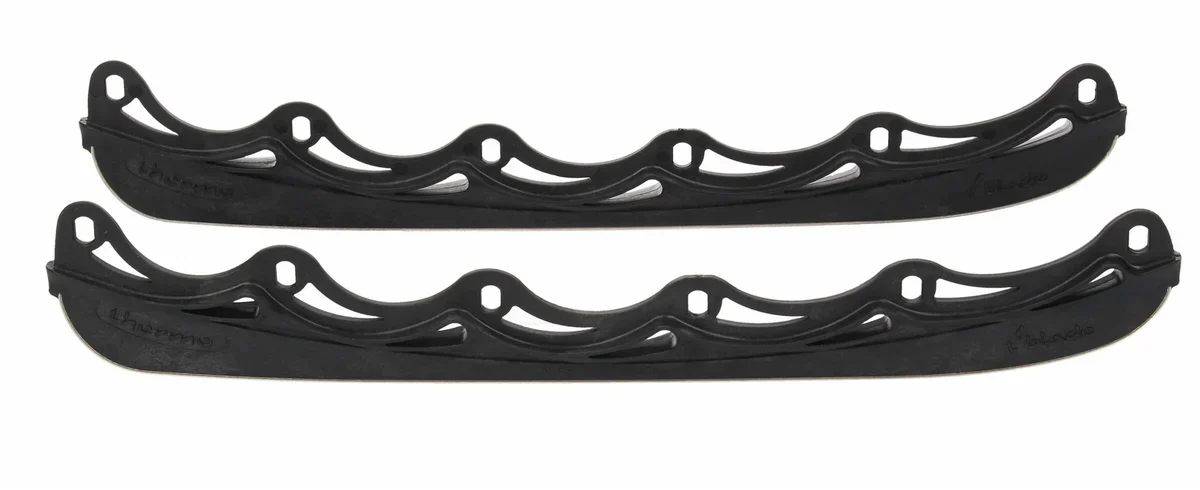
T-Blade (also written t-blade or t’blade) is an interchangeable blade system for skates. Instead of a solid steel blade that has to be sharpened regularly, it consists of a plastic holder and an interchangeable runner. Only a narrow metal strip in the runner touches the ice. When its edge is dull or damaged, the runner is swapped; there is no need for a sharpening appointment.
The manufacturer itself compares the principle to razor blades: the system stays on the boot and the wear part is replaced. Because the runners are industrially made with a fixed hollow radius and consistent rocker profile, every new runner of the same variant is meant to deliver the same feel. T-Blade is designed for ice hockey and recreational skating, not figure skating.
History
Holger Würthner developed the idea of a modular blade system in the early 1990s; the manufacturer gives 1992 as the starting point. At first, t’blade competed against established brands with a complete skate of its own. After difficult early years came a change of strategy: in the early 2000s, the company focused on the blade system itself. According to the company history, the partnership with Graf Canada began in 2002, which among other things fitted the Supra 735 with t’blade. In the mid-2000s, according to the manufacturer, the system was also used in professional sport, up to the NHL.
In 2014, today's t’blade sports GmbH was founded in Türkheim in the Allgäu region, led by Christian Walk. Since then, sales have gone more directly to skaters. In the 2020s, freestyle, personalisation and an online configurator were added.
The components
| Part | Function |
|---|---|
| Holder | Blade holder connecting the boot to the system; optionally as a carbon holder |
| Stabiliser | Fixes the runner in the holder and provides controlled flexibility; with stainless steel or plastic screws |
| Runner | Interchangeable plastic blade with an integrated strip of stainless spring steel |
| Clips | Small system parts that also serve as colour accents |
According to the manufacturer, the holder and stabiliser are made of glass-fibre-reinforced plastic. The optional carbon holder is said to be lighter and more torsionally rigid and is compatible with all other system parts. Black and white runners differ only in colour, not in material or skating properties.
Reading the runner code
Every runner carries a code such as M-11-272. The letter indicates the length of the glide surface (S, M or L), the middle number the hollow radius in millimetres and the last number the system size in millimetres. The system size is also printed on the inside of the stabiliser and on the holder. The manufacturer offers system sizes 248, 256, 264, 272, 280, 288 and 300 mm; 248 mm corresponds roughly to EU shoe size 37.
The manufacturer currently lists hollow radii of 9, 11, 13 and 15 mm. Smaller radii grip more and suit hard ice; larger ones glide better on softer ice. According to the manufacturer, 18 and 21 mm runners are no longer regularly stocked. Once you have found your runner type, simply choose the same combination of length, radius and size when reordering.
How the runner change works
You need the T-Blade system key for the change. It loosens the stabiliser screws; the old runner is removed and the new one inserted and fixed according to the instructions. Check that it is firmly seated before skating again. According to the manufacturer, the change can be done at any time, even right at the boards or in the dressing room. The manufacturer gives no official time for the change.
This is particularly handy when an edge is damaged during training or a game. According to the manufacturer, damage is almost always caused by hard contact, for example with concrete or the goal frame. With a spare runner in your bag, you don't have to wait for a sharpening service. The manufacturer recommends that the initial mounting of the system on the boot is done by trained specialists.
Colours, configurator and Style League
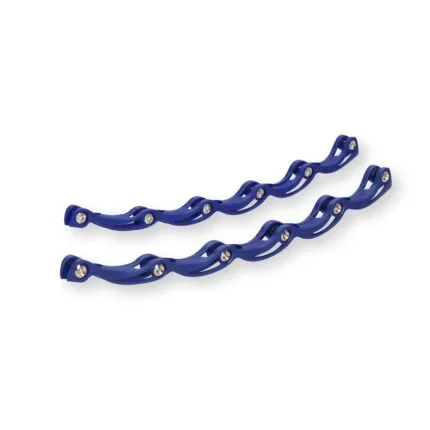
One hallmark of T-Blade is personalisation. Holder, stabiliser, runner, clips and laces can be combined in different colours – for example a black holder, a metallic gold stabiliser, a black runner and metallic gold clips. The range includes black, white, pink, yellow and neon yellow, as well as metallic shades of blue, chrome, gold, green and red.
Interactive
Try a colour combination
Preview using the configurator’s image layers – colours approximated. Only the manufacturer’s configurator shows what is available for a model and size.
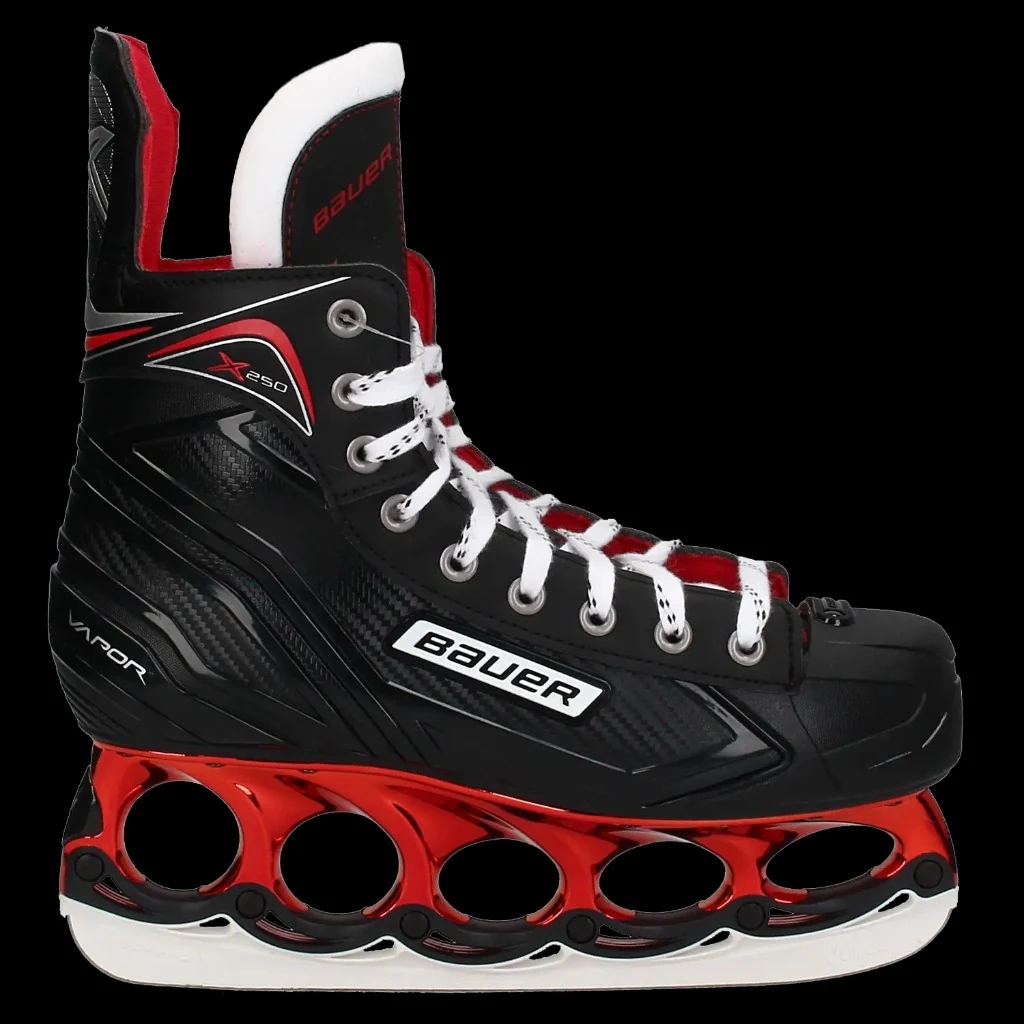


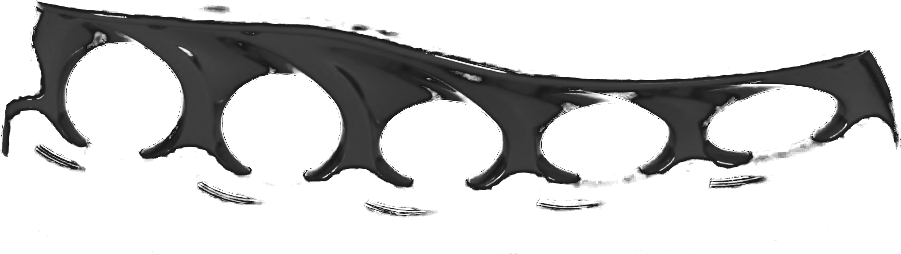

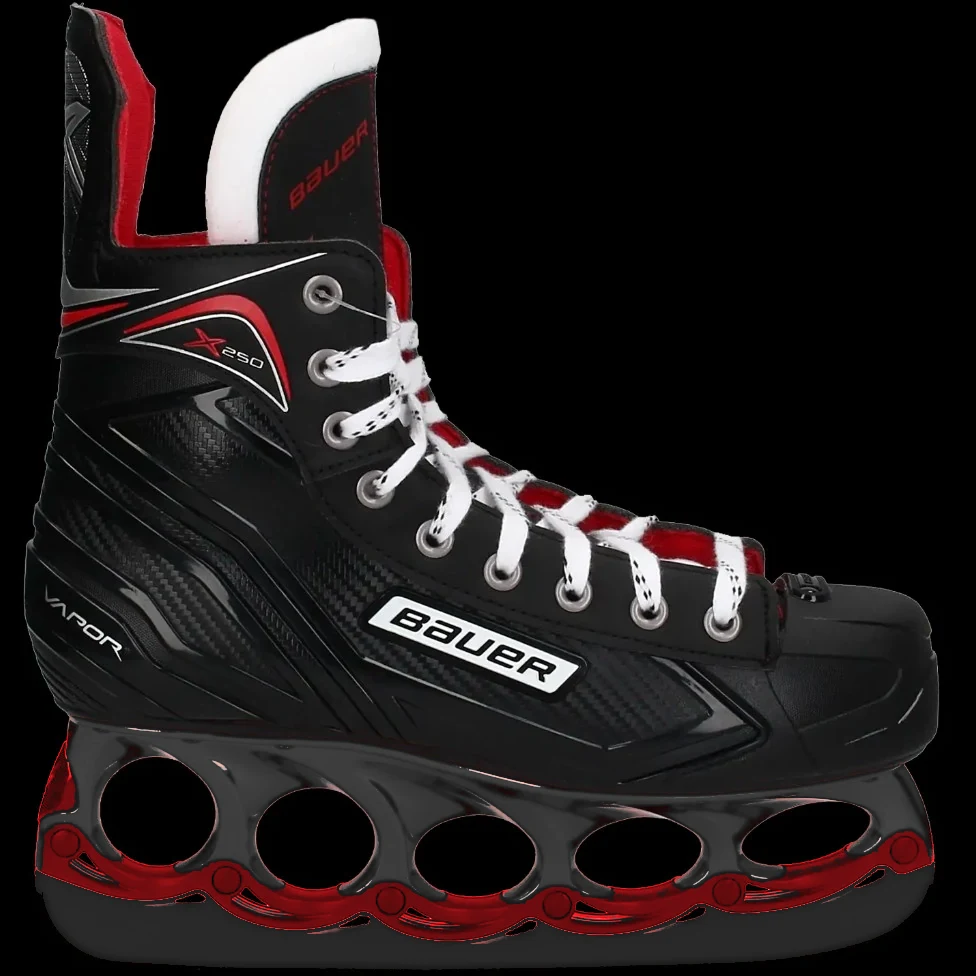
Preview based on the configurator layers from T-Blade (Bauer Vapor X250). Image: T-Blade
Holder Black · Stabiliser Metallic gold · Runner Black · Clips Metallic gold
Examples
Colour names from the manufacturer’s range (as of October 2026). Not every combination is available for every model and size.
The manufacturer's online configurator guides you through brand, model and size and then only unlocks the matching holder, stabiliser, runner, clip and lace variants. According to the manufacturer, it only shows components that are fully available for the chosen combination and confirms compatibility and availability at the end. Finished configurations can be saved and shared via link, for example so that a team can order the same look.
The Style League is a ranking in the shop in which only combinations that have actually been ordered count, not just saved drafts. This shows whether anyone already skates a given combination of boot model and colours. Whoever orders a new combination first can appear with their first name as an Original Rider if they wish. The configurator also shows "popular styles", sorted by how often they are configured, even without a purchase.
Compatibility: which boots?
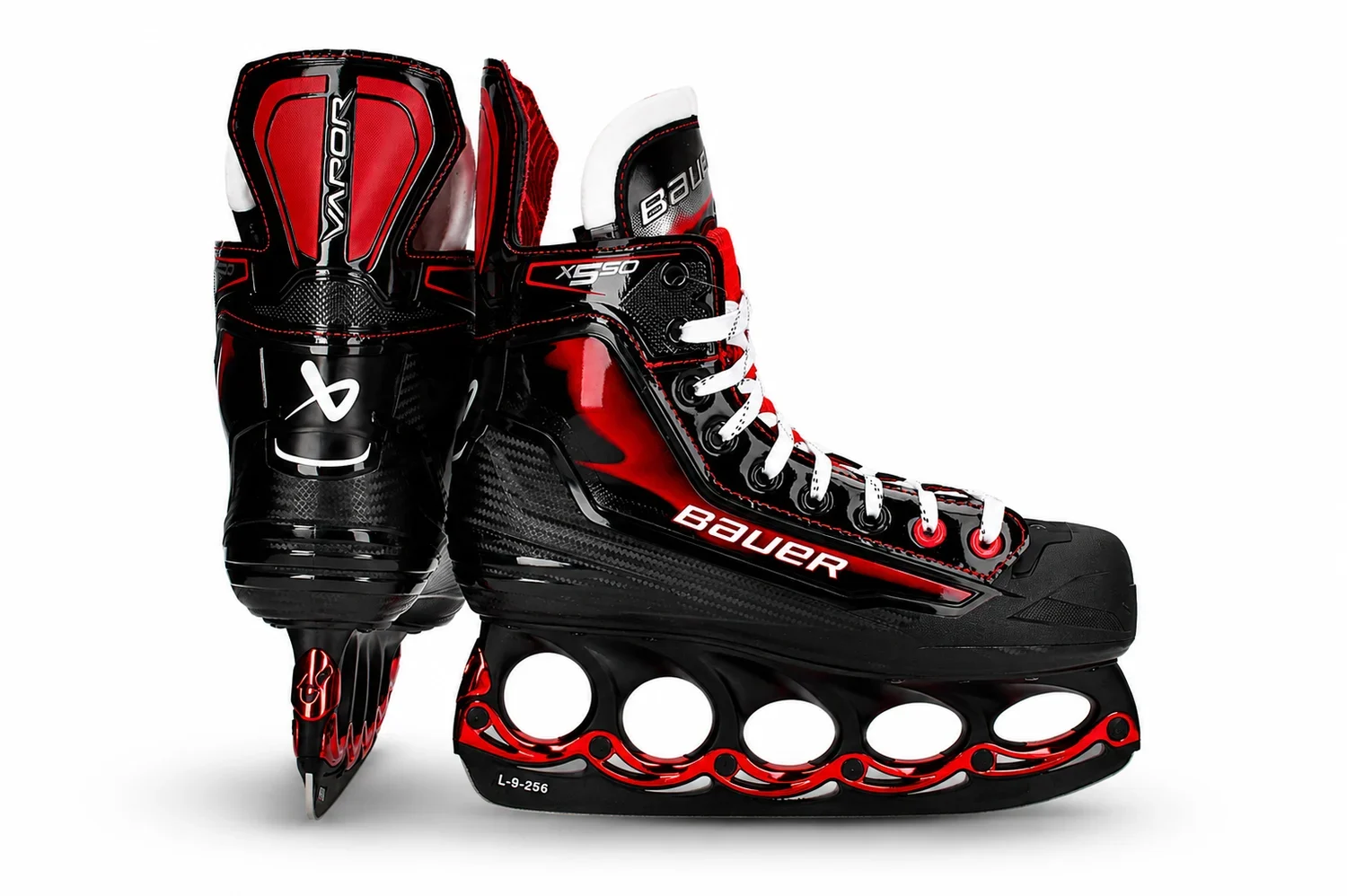
T-Blade is mounted on boots from established manufacturers. The manufacturer's Core Collection consists of complete skates based on Bauer and [Graf](/organisationen/graf) boots with the system pre-mounted, including models such as the Bauer X 550, Bauer Supreme F15, Bauer XLS and Graf Ultra. The shop also has a category for CCM boots; some models there are temporarily unavailable.
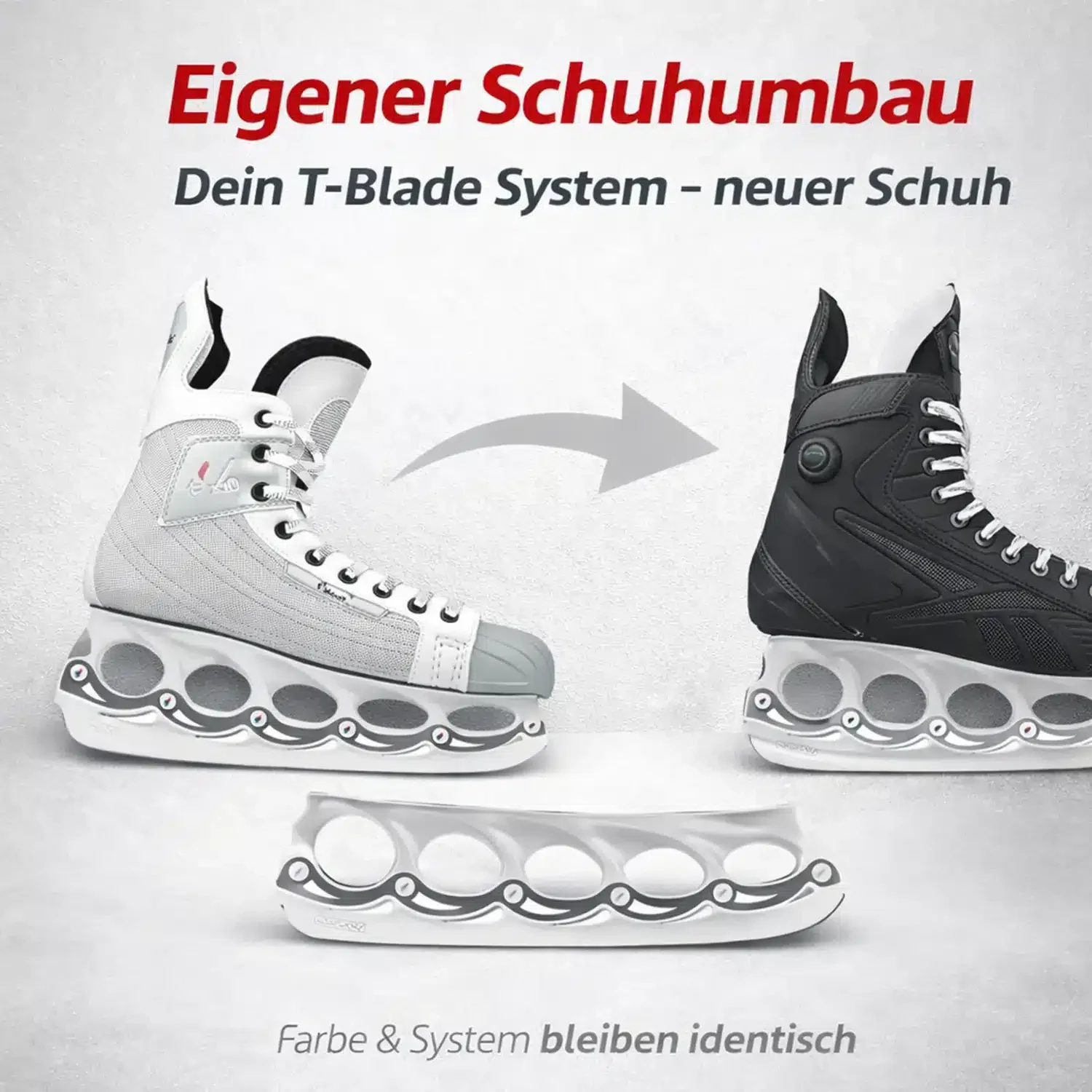
Existing boots can also be converted, but only if the model is suitable. The manufacturer checks in advance whether a boot fits, based on model, size and sole. Conversely, an existing T-Blade system can be transferred to a new boot. According to the manufacturer, the system is designed for a user weight of up to 120 kg.
Pros and cons
Pros
- no sharpening: the edge profile stays the same after every change, and sharpening errors are eliminated
- can be changed on the spot, for example after edge damage during a game
- low weight; the manufacturer describes T-Blade as one of the lightest blades on the market
- many colour combinations and a shareable online configurator
Cons and limitations
- runners are a wear part and have to be repurchased
- not suitable for figure skating, no toe picks
- runners are audibly louder than steel blades; according to the manufacturer, this is due to their flexibility
- a short adjustment period because of the strong glide, which is why starting with 13 or 15 mm is recommended
- initial mounting on the boot by specialists is recommended, and not every boot can be converted
- available mainly through the manufacturer's shop and the outlet store in Türkheim
The manufacturer also claims up to 40 per cent better glide, a service life four to five times longer than conventional steel and a glide surface up to 4 °C warmer. The editorial team is not aware of any independent measurements; these figures should therefore be read as manufacturer claims.
T-Blade compared with a steel blade
| Feature | Classic steel blade | T-Blade |
|---|---|---|
| Dull edge | resharpen | swap runner |
| Profile | set by sharpening | chosen via runner variant |
| Tools | sharpening machine, sharpening service | system key |
| Figure skating | separate blades with toe picks | not suitable |
How ice is made and why its hardness should match the hollow radius is explained in ice preparation and ice temperature. Another blade innovation, from speed skating, is described in clap skate. The company itself is listed on IceHub as T-Blade, and the boot manufacturer as GRAF.
Images: T-Blade ([t-blade.shop](https://t-blade.shop/)), used with permission.
Frequently asked questions
+Do T-Blade runners need sharpening?
No. According to the manufacturer, the runners must not be sharpened conventionally, as this would damage the plastic next to the metal strip. When edge grip declines, the runner is replaced. Small irregularities can be carefully smoothed with a honing stone.
+How long does a runner change take?
The manufacturer gives no official time. The change is done with the T-Blade system key, which loosens the stabiliser screws; according to the manufacturer it can be done at any time, even right at the boards or in the dressing room.
+Which boots does T-Blade fit?
Complete skates with T-Blade pre-mounted are available based on Bauer and Graf boots, and the shop also has a category for CCM. Existing boots can be converted if the model is suitable; whether a boot fits is checked in advance based on model, size and sole.
+Is T-Blade suitable for figure skating?
No. The system is designed for ice hockey and recreational skating and has neither toe picks nor figure skating geometry.
+Which hollow radius should I choose?
The manufacturer recommends 9 and 11 mm for more edge grip on hard ice and 13 and 15 mm for more glide on softer ice. For new users, it recommends a flatter radius of 13 or 15 mm.
+What is the Style League?
A ranking in the manufacturer's shop in which only colour combinations that have actually been ordered count. Whoever orders a new combination first can appear with their first name as "Original Rider" if they wish.
Sources & further links
- T-Blade: Was ist t-blade? Das Kufensystem ohne Schleifen (Hersteller-FAQ)
- T-Blade: Über uns – Geschichte des Systems
- T-Blade: Saisonstart 2026 – Konfigurator, Style League & dein eigener Style
- T-Blade: Startseite (Komponenten, Core Collection, FAQ)
- T-Blade: Konfigurator
- T-Blade: Eigener Schuh mit Montage
- T-Blade: Runner verstehen – Guide zur Auswahl
Editorially researched and checked against association and rulebook information. Found a mistake? Write to us via the Contact page.
Read more in the encyclopedia
Sport
Ice hockey
Ice hockey is a team sport on skates in which two teams, each with five skaters and a goaltender, try to put a hard rubber puck into the opposing goal with their sticks. Three periods of 20 minutes of effective playing time are played.
Term
Clap skate (klapskate)
The clap skate (Dutch: klapschaats) is a speed skate whose blade is attached to the boot at the front via a hinge and detaches at the back. This keeps the blade on the ice longer during the push-off. It has been standard since the late 1990s.
Background
Ice preparation & ice resurfacer (Zamboni)
The ice resurfacer shaves a thin layer off the ice, collects the resulting snow, cleans the surface and lays down a thin film of warm water that freezes into a smooth new layer of ice. Frank Zamboni built the first such machine in California in 1949.
Background
Making ice & ice temperature by sport
Artificial ice is made by applying water in many thin layers to a chilled concrete slab containing cooling pipes. The finished ice is usually only a few centimetres thick. The ice is tempered differently depending on the sport: colder and harder for ice hockey and speed skating, slightly warmer and softer for figure skating.
Sport
Figure skating
Figure skating combines athleticism and expression: skaters perform jumps, spins and step sequences to music, which a judging panel scores under the ISU judging system. Olympic disciplines are singles, pair skating, ice dance and the team event.
Sport
Ice & technology
Everything about Ice & technology: rules, history, numbers and all terms.